

On 2 June, at Money20/20, the UK Payments Initiative (UKPI) launched its scheme for commercial variable recurring payments. The FCA welcomed it the same day, alongside its open finance roadmap. Credit where credit is due, because Richard Koch and the UKPI team have pulled off something genuinely difficult. Twenty-three founding shareholders now sit behind one rulebook, with Barclays, HSBC, Lloyds, NatWest, Monzo and Revolut on the account-holding side, and GoCardless, Plaid, TrueLayer and Yapily amongst those initiating the payments.
Most of the coverage has treated the launch itself as the story. Todd Clyde, chief executive of Token.io, called it the first new UK payment scheme in nearly twenty years, and the reaction across the ecosystem ran just as warm. I would put the emphasis somewhere else. The event that actually mattered happened back on 20 January, when the FCA and PSR said they would not prioritise a competition investigation into the scheme’s centrally set access fee. In my view the launch is the trial, and January’s pricing statement was the unlock.
That reordering matters because it changes what UKPI actually is. Rather than the UK simply acquiring a new payment product, what I see is the UK running a controlled experiment on the question that has hung over open banking since 2018, namely whether the rails improve once somebody is finally paid to run them.
cVRP swaps an after-the-fact refund right for a cap the payer sets
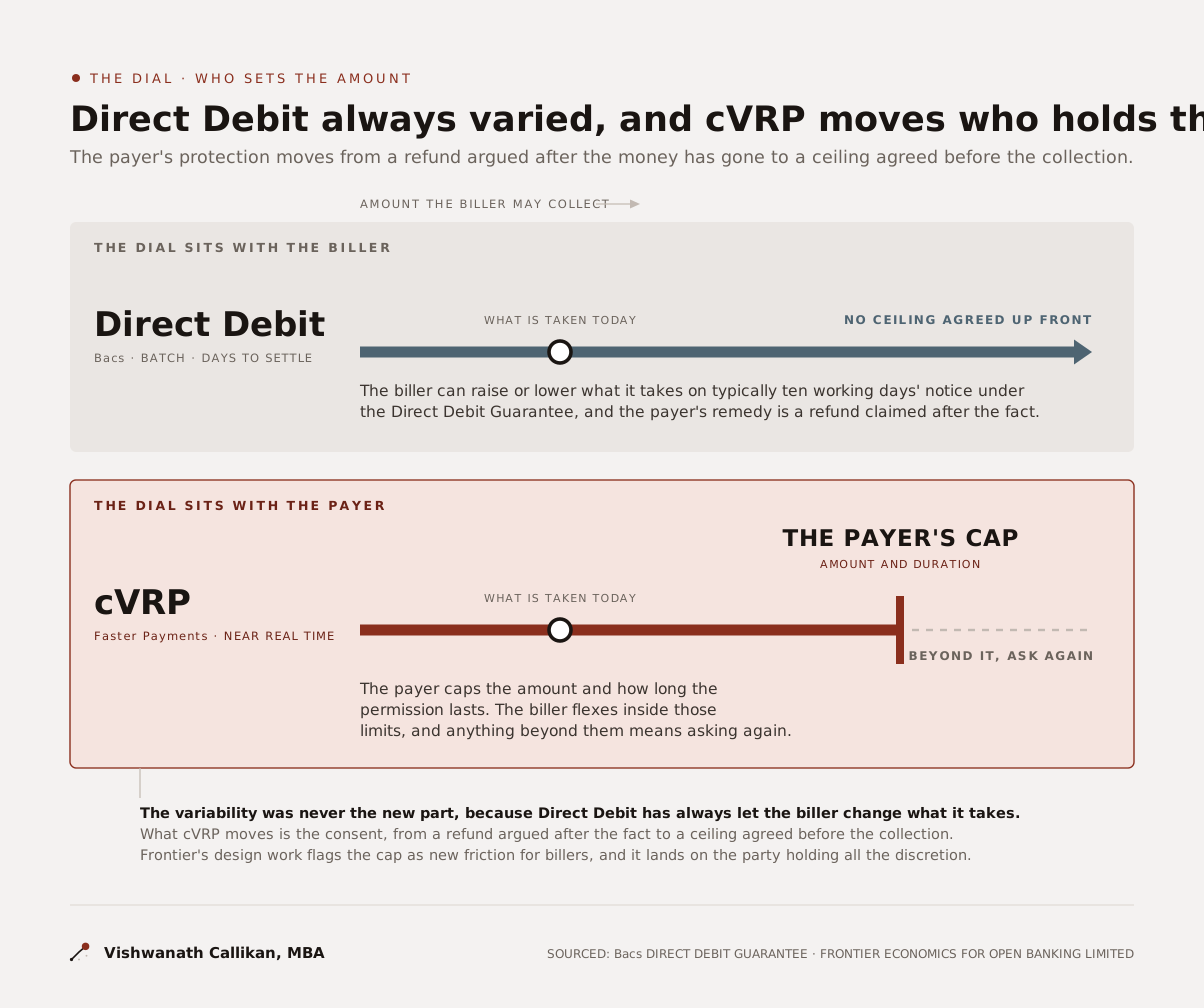
It is worth being precise about what commercial VRP actually replaces, because the obvious description of it is wrong. Direct Debit amounts are not fixed to begin with. A utility collecting by Direct Debit can change what it takes, provided it gives advance notice under the Direct Debit Guarantee, typically ten working days. So the variability has always existed, and it has always belonged to the biller, whilst the payer’s protection is a refund right exercised after the fact, on a batch rail that settles over days.
cVRP inverts the ownership of that variability. The payer agrees a mandate that caps how much can be taken and how long the permission lasts, and the biller can then flex its collections inside those limits, whilst anything beyond them means coming back to ask. The payment itself clears in near real time over Faster Payments rather than in an overnight batch. The scheme’s own design analysis is candid that this cuts both ways, since a biller that can unilaterally amend a Direct Debit today may find mandate limits an added friction tomorrow. In my view that caution deserves less weight than it first appears to, because the friction lands on the party that currently holds all of the discretion.
The product on offer is not variable payments but payer-held variability on a real-time rail.
None of this needed new pipes. The mandate limits and the real-time clearing both run on the open banking APIs that have existed since 2018, which raises the obvious question of why a scheme built on top of them took eight years to arrive.
The CMA mandate made the rails free, and that was the problem
Open banking’s plumbing exists because the CMA ordered it into existence following its 2016 retail banking market investigation, with the largest banks required to provide it without charge. That mandate did its job. The UK now has more than 16 million active users, with payment volumes up 53% year on year. UKPI counts over 37 million payments a month. VRPs already account for 16% of open banking payments, albeit mostly the free ‘sweeping’ kind, where money moves between a person’s own accounts.
However, the mandate also fixed the economics at zero. A third-party provider could build a business on the APIs, but the bank underneath could not, and that asymmetry has been a standing grievance amongst banking providers well before cVRP existed.
The UK’s own regulators eventually conceded the point. Premium API pricing, the JROC ruled in the principles it set out for banks and third parties, has to “incentivise investment and innovation”, which reads to me as a tacit admission that an unpriced mandate never would.
Industry voices had made the same complaint more bluntly for years. With no revenue line attached to the API estate, a bank had no commercial reason to run it as anything more than a compliance obligation, and it was maintained accordingly.
This is the distinction I keep coming back to across markets, between compliance-grade rails and commercial-grade rails. A compliance-grade rail meets the specification, whilst a commercial-grade rail is somebody’s product, with uptime, latency and roadmap treated as things customers pay for.
A rail that nobody is paid to run will be run as a compliance artefact, and maintained exactly like one.
The industry’s own principles for the next phase, agreed with the FCA in 2025, say much the same thing in politer language, listing sustainable commercial models as a precondition for open banking to scale.
The access fee runs from biller to PISP to sending bank, and never to the payer
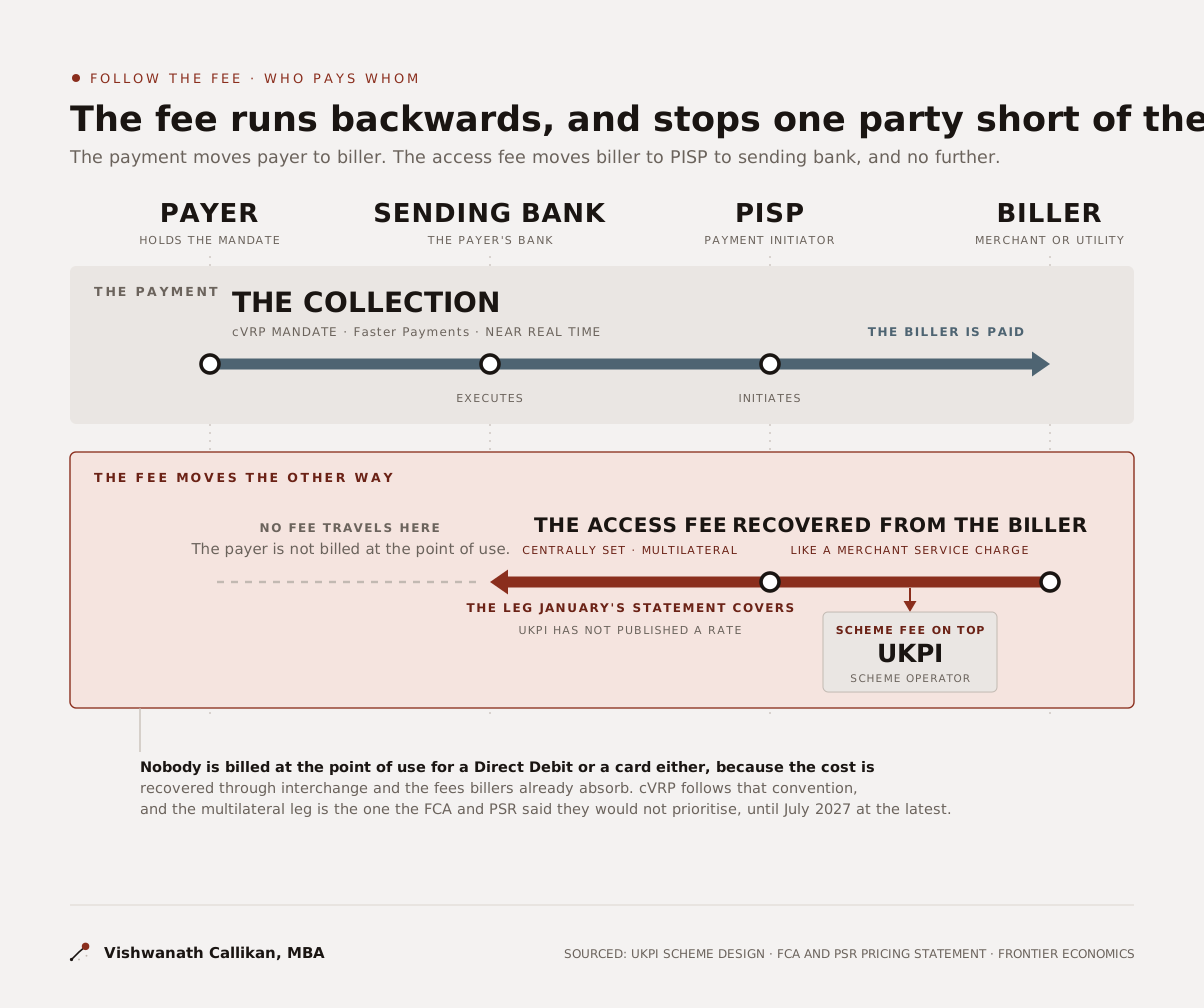
If the rails needed a price to become commercial-grade, the obvious next question is who pays it. It is not the payer, at least not directly. Nobody is billed at the point of use for Direct Debit or for a card either, even though running both costs something real, and that cost is simply recovered elsewhere, folded into interchange and the fees billers already absorb rather than charged at the till.
cVRP follows the same convention by design, and the money flows the other way through the stack instead. The payment initiator (the PISP) pays the sending bank a centrally set access fee under a multilateral agreement, then recovers it from the biller it serves, much the way merchant service charges work today. The scheme operator is funded by a scheme fee on top.
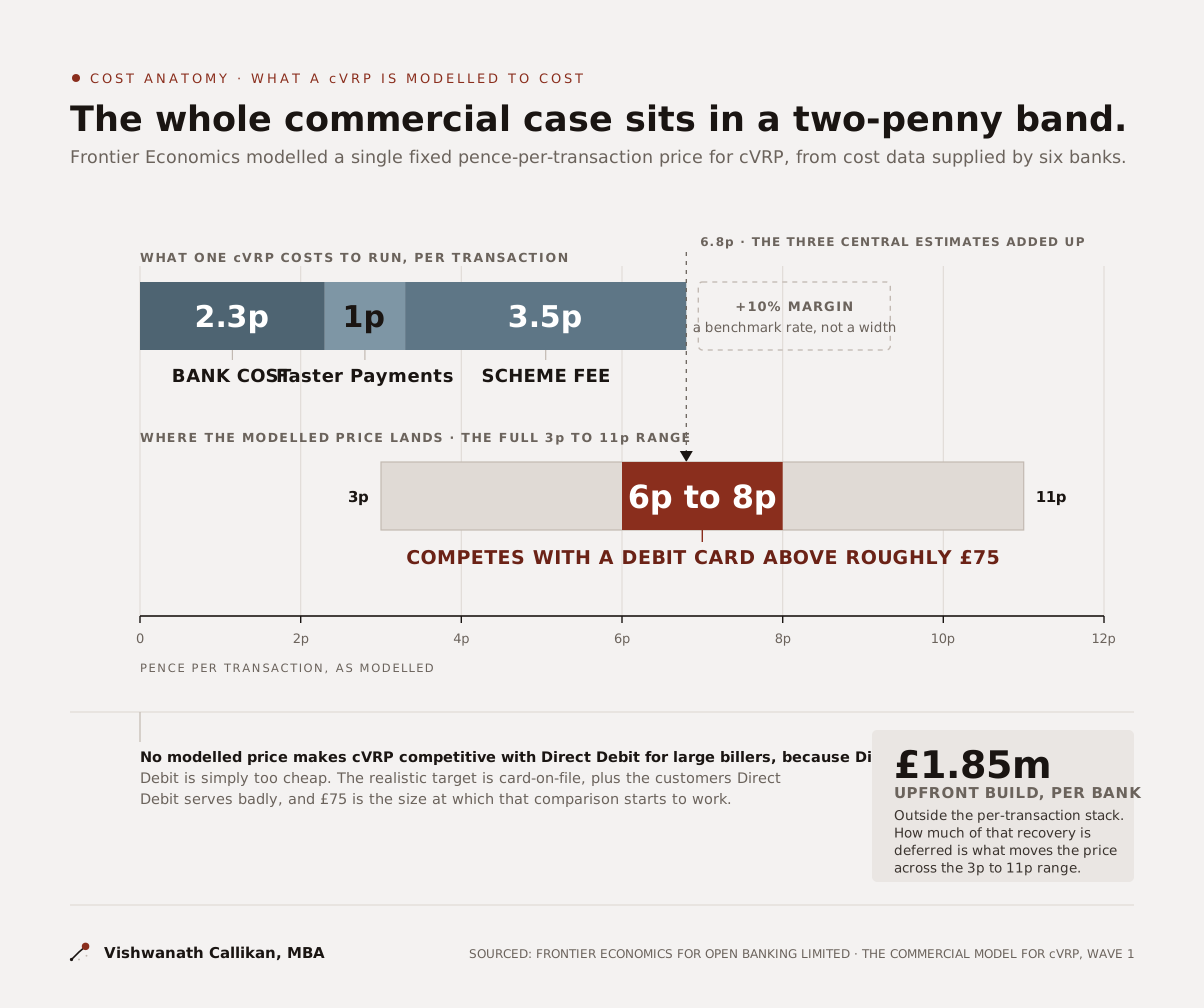
UKPI has not published a headline rate, but the design work underneath it is public and worth reading. Frontier Economics, commissioned by Open Banking Limited, recommended a single fixed pence-per-transaction price, held for roughly five years, and modelled its anatomy from data supplied by six banks. The central estimates run at about 2.3p of bank cost per transaction, 1p of Faster Payments cost and around 3.5p of scheme fee, with a 10% margin benchmark on top, and each bank facing roughly £1.85m of upfront build.
Depending on how much of that cost recovery is deferred, the modelled price lands anywhere between 3p and 11p per transaction, with 6p to 8p identified as the balance point at which cVRP becomes competitive with debit cards above roughly £75.
What January’s statement is not also matters. A multilateral agreement in which competitors jointly set a price is exactly the shape of thing competition law exists to examine, which is why the FCA and PSR issuing a non-prioritisation statement, with the CMA concurring, was the unlock. It is forbearance rather than approval, it can be revisited if the pricing methodology changes, and it expires when the legislative framework arrives or in July 2027, whichever comes first. The regulators have, in effect, lent the experiment a window.
UKPI’s own modelling is modest, and that is what makes it a fair test
That window is worth spending well, so it is worth checking what it has actually bought. The enthusiastic coverage tends to skip the modest part. Frontier’s analysis states plainly that no pricing scenario makes cVRP competitive with Direct Debit for large billers, because Direct Debit is simply too cheap. The realistic target is card-on-file, plus the customers Direct Debit serves badly, and the central adoption case is a 2.5% share of Wave 1 use cases five years after launch. Nobody inside this scheme believes they are killing Direct Debit next year, whatever the vendor decks say.
So the experiment is better judged on what it is actually testing. Sending banks earn no per-transaction margin on Direct Debit, and cVRP is the first open banking payment where a scheme-set price gives the bank one. Bilateral premium-API deals existed before this, but a bilateral deal is only a contract, whereas a multilateral price is a market. The question is whether that margin, at whatever rate the scheme has set, is enough to make banks treat their API estates as revenue infrastructure.
I would not look for the answer in press releases. It should show up in the published API availability and latency figures, in how fast Wave 2 pricing for eCommerce gets agreed, and in whether banks beyond the founding shareholders join without being ordered to. UK Finance has a proposal on the table for that Wave 2 model, with fee levels expressly undecided.
The EPC built SPAA first, and the supply side never joined
The UK is not the first market to attempt commercial open banking payments, but it is the first to attempt them with the supply side actually inside the room. The EU’s equivalent is the European Payments Council’s SPAA scheme, a voluntary framework for premium account access with a rulebook published back in 2022. As of the EPC’s own status update to the Euro Retail Payments Board late last year, SPAA had five participants on the demand side, none on the supply side, a pilot that never materialised, and a workplan on hold whilst it waits for a stable Payment Services Regulation.
In my reading the contrast is structural rather than a matter of British boldness. UKPI’s banks co-funded the scheme, so they hold equity in its success, and the regulators supplied pricing certainty ahead of statute, with HM Treasury legislation expected in 2026 and an FCA consultation on the long-term framework before year-end. SPAA offered banks a rulebook and an invitation, whereas UKPI offered them ownership and a price, and only one of the two has a launch date behind it.
The UK’s wager is on sequencing. Price the rails first, legislate second, and let the legislation inherit a working market instead of designing one on paper.
The direction of travel runs through subscriptions, in Europe as much as the UK
Zoom out and the UK experiment stops looking local. The EPI’s own roadmap for Wero, Europe’s account-to-account wallet, points towards subscriptions, pay-per-use and instalment payments as it expands eCommerce across Germany, Belgium, France, Luxembourg and the Netherlands. I have written before about how Wero’s scheme externalises its settlement and buys its reach, and recurring commerce is where its economics will have to be earned. The market, in other words, is converging on the same territory, the steady payments that run households and subscriptions, with each scheme arriving at a different answer to who pays for the rails.
The UK’s answer is now live and priced. By the end of 2027 I would expect us to know whether a paid rail behaves differently from a free one. If bank API performance climbs and Wave 2 pricing lands, January’s dry competition-law statement will be remembered as the moment UK open banking became a market. Should neither happen, the lesson will be that the fee was set against the wrong number, and that is worth knowing too. Either way, the UK is generating the evidence everyone else will regulate on.