
Wero has enrolled more than 50 million people across its European launch markets in its first eighteen months. On the headline curve that is one of the fastest adoption stories payments has produced, faster than iDEAL ever managed in the Netherlands and in the same conversation as Pix and UPI, the two account-to-account systems that reset everyone’s sense of how quickly a new rail can scale.
Read as a scale story, that curve invites the conclusion that Europe finally has its answer to Visa and Mastercard. In my view the reading mistakes the easy half of the problem for the whole of it, because most of Wero’s reach was acquired rather than earned, and the difference between those two words carries everything that happens from here.
My earlier two-part series on Wero, “the scheme that never touches the money”, worked through the settlement mechanics, and how the European Payments Initiative (EPI) keeps the rulebook, the brand and the coordination whilst handing settlement entirely to SEPA Instant and the Eurosystem’s TIPS. Part 1 sets that out in full. The question here is a different one, and it is not whether the architecture works but whether the habit forms.
Wero bought its early market instead of crossing it
Where the users came from reframes the growth curve immediately. Wero did not sign up its first tens of millions one enrolment at a time. In France it absorbed Paylib and its roughly 35 million users. Across the Benelux it inherited the books of iDEAL and Payconiq, both acquired by the EPI in 2023.
The wallet is embedded directly inside the apps of the 16 banks and payment providers that back the EPI, so for a large share of European current-account holders Wero arrived as a feature of a bank they already used rather than as an app they chose to download. The rail underneath it, SEPA Instant, was already built and paid for by the Eurosystem. On top of that, the Instant Payments Regulation caps what a bank may charge for an instant euro transfer at no more than it charges for a standard one, which removes the price penalty that held instant payments back for years.
I do not offer any of that as criticism, because it is a genuinely clever way to skip the years of grinding, expensive early-adopter acquisition that every new payment method usually has to survive. It does mean the headline user number describes distribution assembled through acquisition and integration rather than demand that was won. Wero bought a standing start that looks, on a chart, like a running one.
Registered users and monthly users are not moving together
If the reach were also habit, the two numbers would move together. They do not, and the EPI’s own partners are refreshingly precise about it. In the initiative’s twelve-month release, Crédit Agricole reports that “nearly 5 million” of its customers use Wero every month, and Groupe BPCE reports adding “200,000 new user customers each month.” Set those against a registered base of 43.5 million at the same date and the shape of things is hard to miss. Registration is running an order of magnitude ahead of regular use.
That gap is the normal condition of a young payment method which has solved distribution before it has solved behaviour, and I would not read it as failure. It is also almost entirely concentrated in one use case. Wero today is a peer-to-peer tool, used to split a bill or settle a second-hand sale, which is exactly where a wallet with an inherited base and no merchant network can gain traction first. The harder surfaces, eCommerce and the point of sale, are only now arriving.
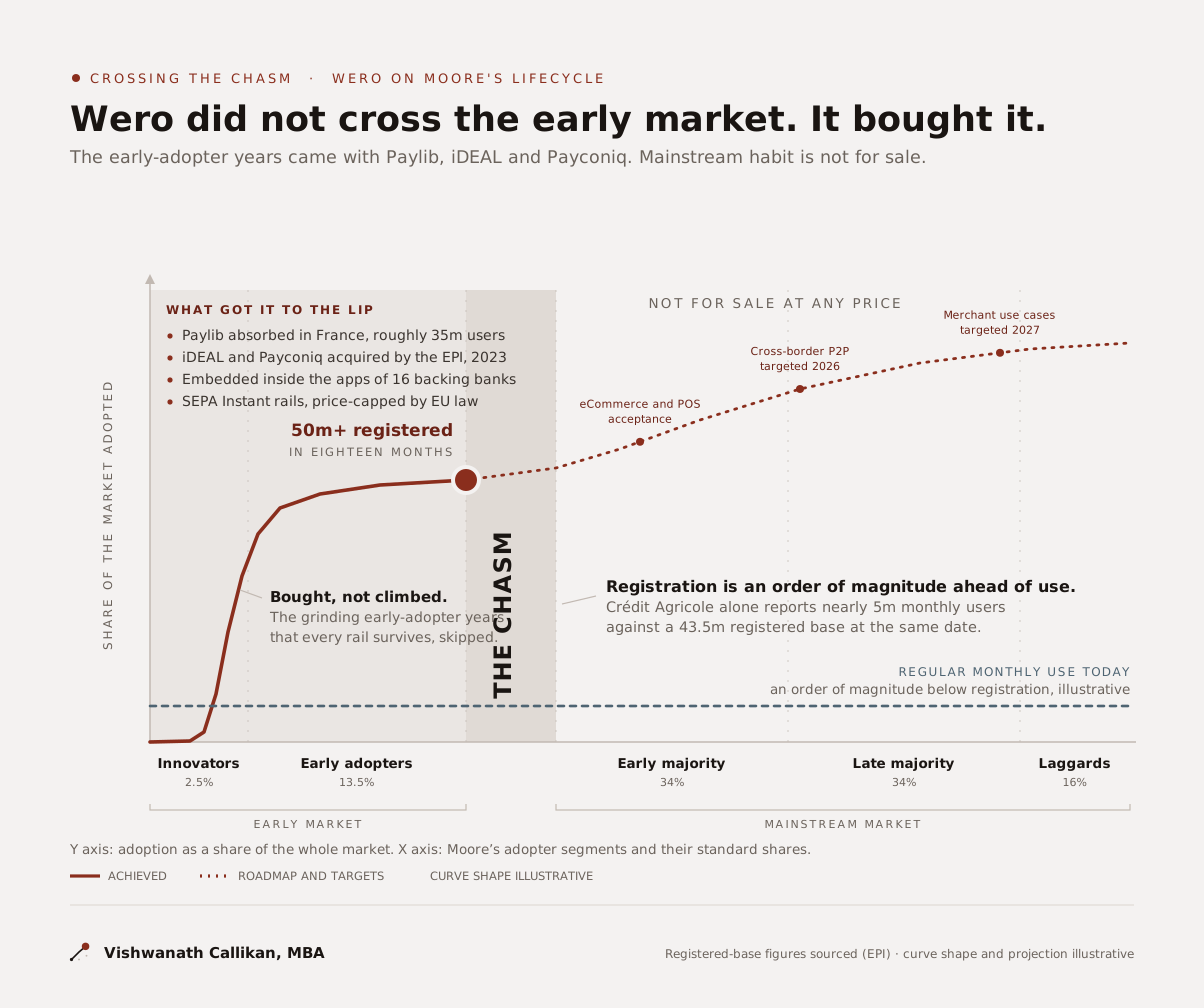
Geoffrey Moore’s old chasm is the right picture here, with one correction. Wero did not climb the early-adopter slope at all, but bought its way to the lip of the chasm, and it is standing there now. The early market, the part that usually takes years, it acquired cheaply. The mainstream market on the other side, where a payment method becomes the thing a shopper reaches for without thinking, cannot be acquired at any price, and it has to be used into existence.
Reach is a stock Wero could buy, and habit is a flow it has to earn
Most of the coverage collapses reach and habit into a single number, and the distinction between them is the one I want to make load-bearing. Reach is a network property whilst habit is a behavioural one, and the two are paid for in completely different currencies. Reach is a stock. It can be acquired once, through a roll-up, an alliance, or a default placement inside a banking app, and then it sits on the balance sheet. Habit is a flow. It accrues only through repeated and chosen use, and it has to be re-earned every time a shopper stands at a checkout with a card within easy reach and decides, again, to open Wero instead.
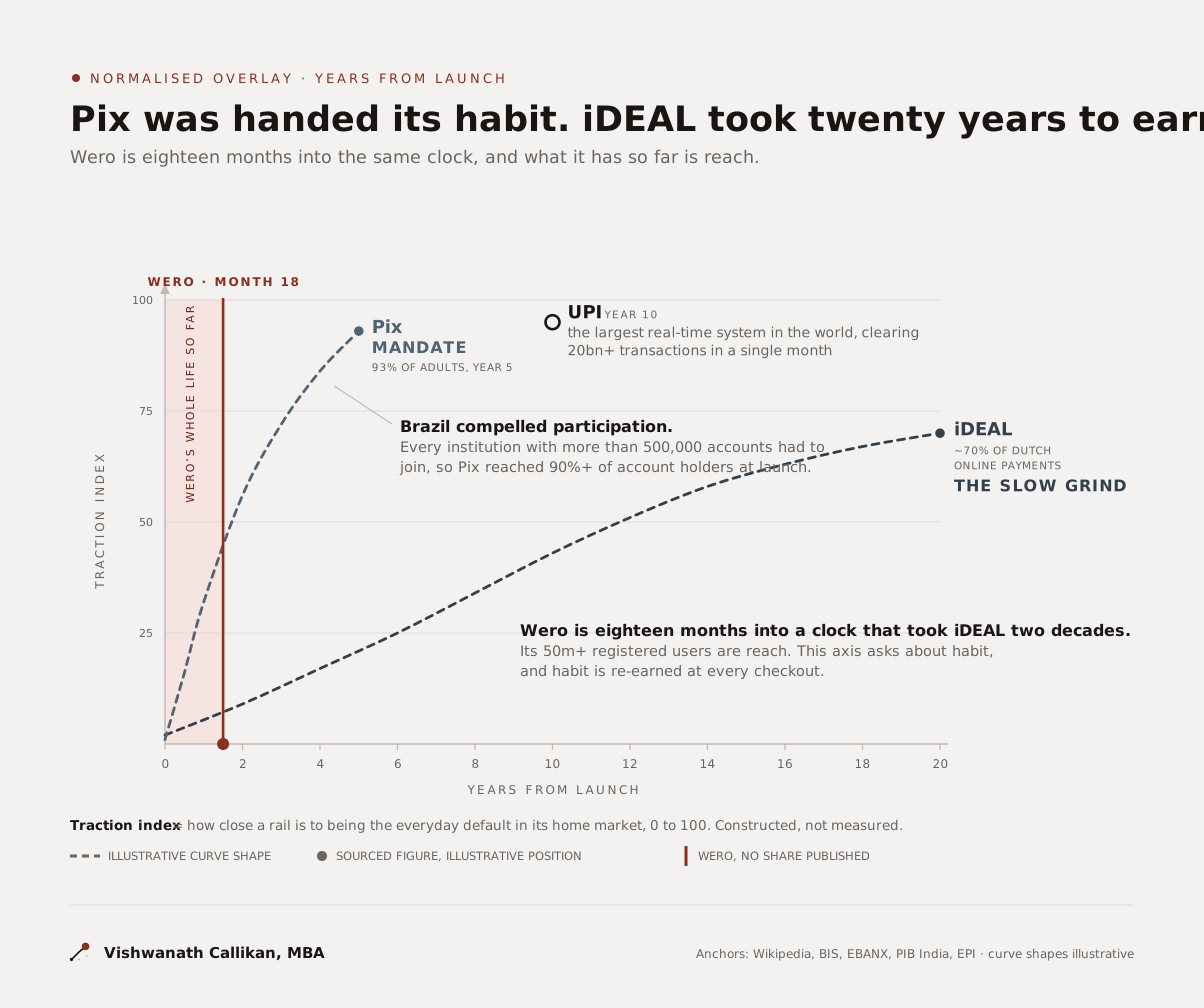
Put those two currencies on the same clock and the contrast is stark. iDEAL took the better part of two decades to reach roughly 70% of Dutch online payments, grinding up through the low double digits year after year, because it was earning habit the slow way, merchant by merchant and purchase by purchase. Wero assembled tens of millions of users in a fraction of that time, because what it was buying was reach rather than habit. The curves look similar and mean opposite things.
The last mile of a payment scheme is the distance between being installed and being chosen. It is not a network anyone can finish building, and it is the stretch where an inherited base stops helping.
Habit is the one asset in this business that cannot go on a purchase order.
A central-bank mandate handed Pix the acceptance Wero has to negotiate
The two systems everyone benchmarks against are more instructive than they are impressive, and the reason has nothing to do with engineering. Pix and UPI did not out-engineer the habit problem. Each of them had it solved on their behalf by a central actor with the authority to compel ubiquitous acceptance, which is the one condition everyday habit needs.
Pix is the sharpest case. Brazil’s central bank did not wait for banks to adopt its instant rail voluntarily. It mandated participation for every institution holding more than 500,000 accounts, which meant Pix was available to well over 90% of Brazilian account holders from the day it launched. A shopper never had to wonder whether the person or merchant on the other side could receive a Pix, because everyone could, immediately, by law.
On that foundation the behaviour compounded fast, and Pix is now used by around 93% of Brazilian adults. UPI reached similar ubiquity through a differently shaped but equally coordinated push from the NPCI and India’s regulators, and it is now the largest real-time system in the world, clearing more than 20 billion transactions in a single month.
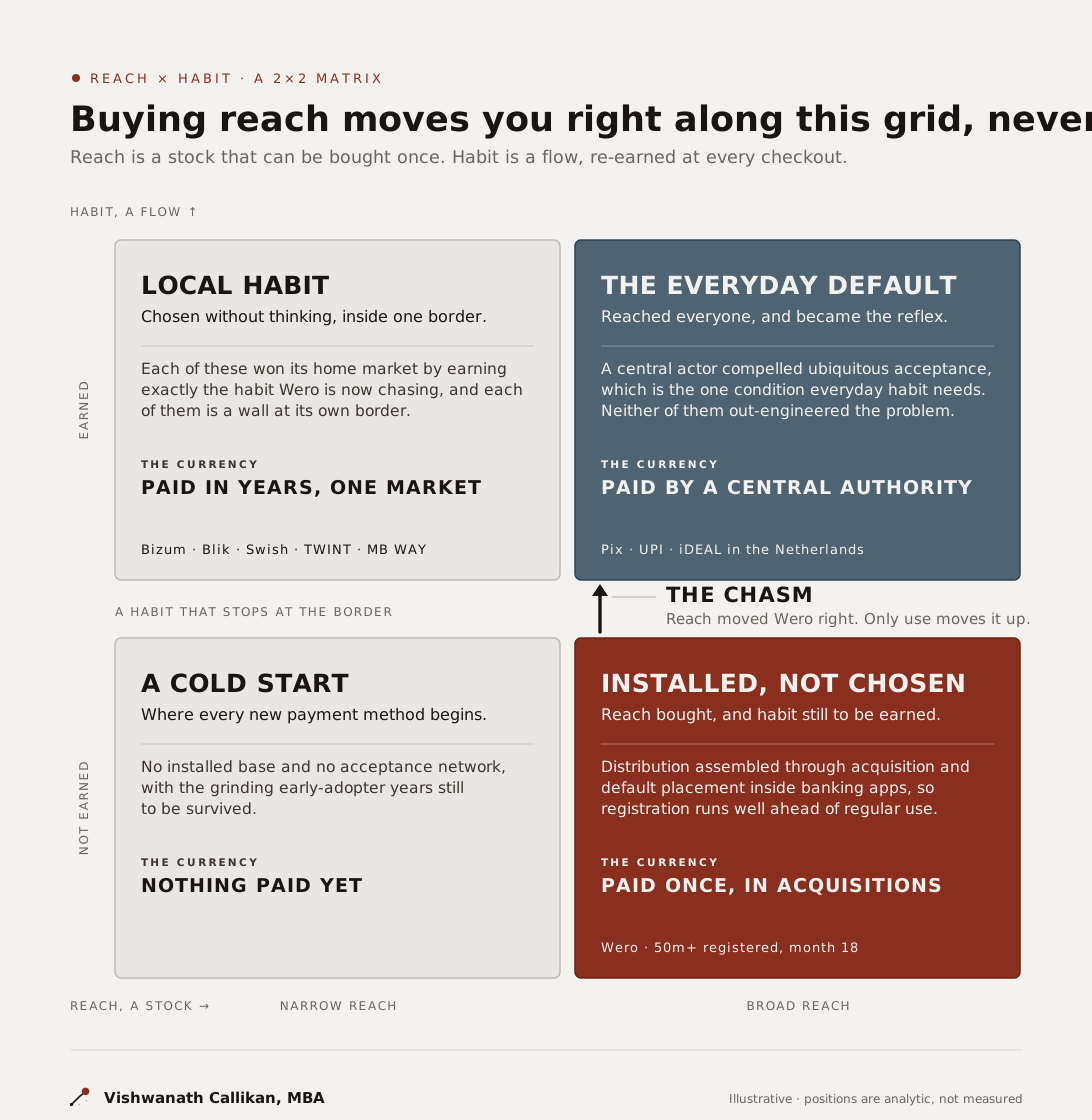
Wero has no equivalent lever. There is no European authority that can, or will, compel every merchant terminal and every bank to accept it on a fixed date. The EPI is a bank-led venture operating across sovereign national markets, and it is assembling acceptance the hard way, one acquirer and one merchant at a time. I would not call that a flaw in the plan, because it is the plan, and it is honest about the mainstream side of the chasm being crossed on foot.
What Pix got by mandate, Wero has to earn by adoption.
Europe is dozens of national A2A islands with dozens of entrenched habits
Acceptance is hard to assemble in Europe for a reason worth drawing out, because it is the real terrain. Europe is not one payments market with a missing scheme, but dozens of national A2A islands, each with its own entrenched habit: Bizum in Spain, Blik in Poland, MB WAY in Portugal, Bancontact and Payconiq in Belgium, Swish in Sweden, Vipps MobilePay across the Nordics, TWINT in Switzerland, and Satispay and Bancomat in Italy. Each of them won its home market by earning exactly the habit Wero is now chasing, and each of them is a wall at its own border. A Dutch shopper’s iDEAL is useless to a Spanish merchant, and always has been.
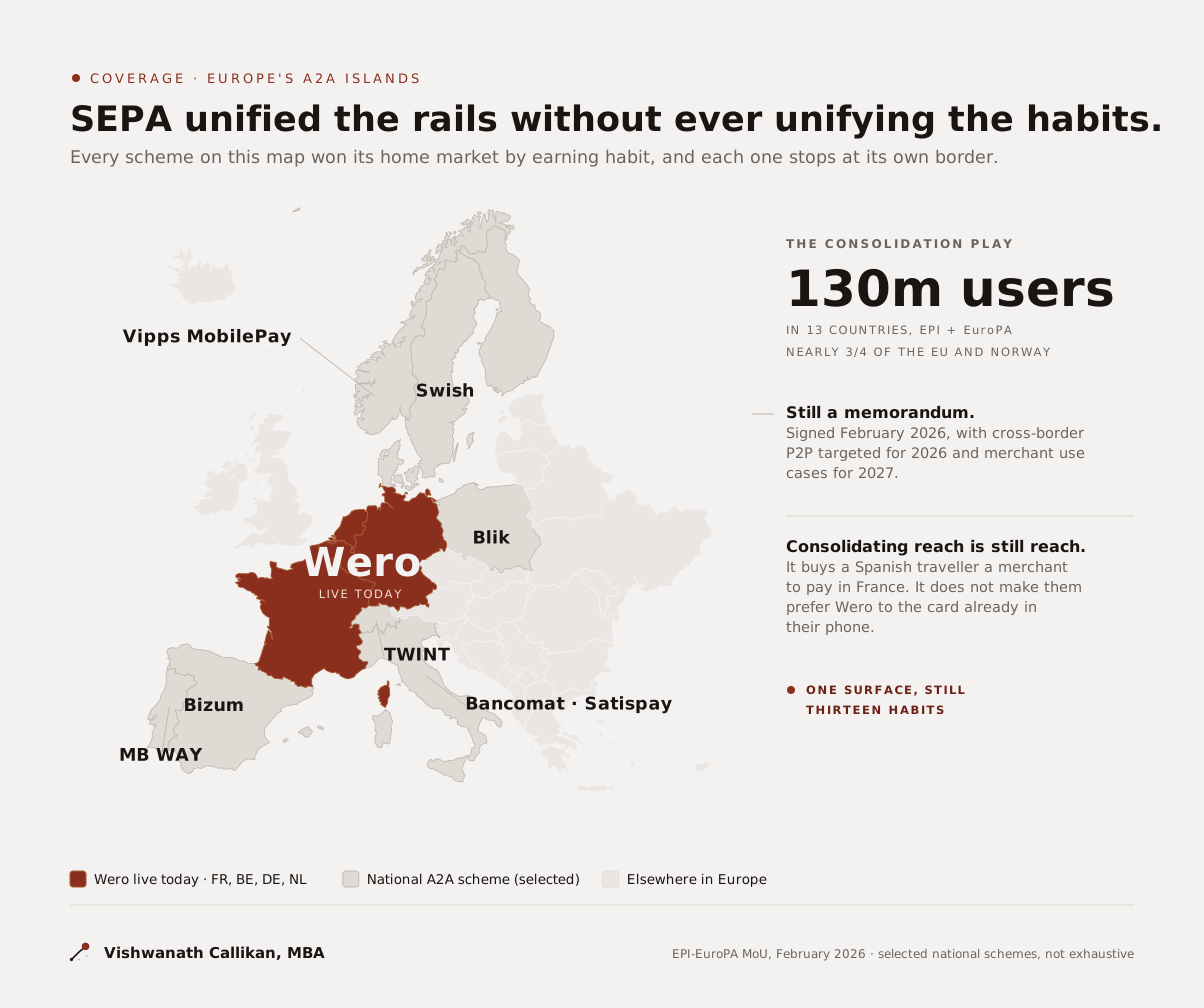
Harmonised rails never closed that gap. SEPA unified the plumbing of European transfers two decades ago, and it did not unify the habits sitting on top of that plumbing, which is why the map stayed fragmented long after the rails were common. Wero’s consolidation play is aimed squarely at that residue. In February 2026 the EPI signed a memorandum of understanding with the EuroPA Alliance, the coalition behind Bizum, Bancomat, MB WAY and Vipps MobilePay, to build cross-border interoperability across a combined base of roughly 130 million users in 13 countries, close to three-quarters of the EU and Norway’s population. In my view it is the most credible attempt yet to turn a continent of islands into a single cross-border surface.
It is also, for now, a memorandum. Cross-border peer-to-peer is targeted for 2026 and merchant use cases for 2027, and a memorandum of understanding is a statement of intent rather than a live capability. The ambition is the right one, and consolidating fragmented reach is genuinely valuable, albeit still consolidation of reach. Stitching the islands together gives a Spanish traveller a merchant to pay in France, and it does not, by itself, make them prefer Wero to the card already in their phone.
Sovereignty motivates the banks that build the rail, not the shoppers who use it
A powerful political wind sits behind all of this, and which side of the market it actually fills is worth being precise about. European payments sovereignty has become an explicit strategic goal. ECB President Christine Lagarde has warned that Europe “urgently” needs to reduce its dependence on Visa and Mastercard, framing reliance on foreign payment systems as a question of sovereignty rather than convenience. With the two US networks moving around $24 trillion a year between them, and the data trail leaving European jurisdiction on every tap, Brussels increasingly treats the dependence as a strategic vulnerability. Not everyone reads it so charitably, and some observers frame the push as protectionism against American technology as much as genuine resilience. That tension is real.
Either way, sovereignty is a force on the supply side. It motivates banks, regulators and governments to build, fund and prefer a European rail, and that support is a serious advantage most challengers never get. What it does not do is make a single shopper tap Wero at a till. Nobody chooses a payment method for geopolitics, and they choose it because it is faster, cheaper to them, more rewarding, or simply already the thing their thumb reaches for.
Political will can push a rail into existence and into every bank, and it cannot walk the last mile, because that mile belongs to shoppers who do not read ECB speeches.
Wero’s roadmap reads as a list of habit levers, use case by use case
The part of Wero’s plan that matters most is also the least glamorous. It is the sequencing of use cases, and the friction being ground down inside each one. The early evidence from Germany’s eCommerce launch is a fair picture of the work involved. At the first merchants the payment worked cleanly only for customers of some banks whilst others hit errors depending on rollout status, the QR-based flow was unfamiliar to shoppers trained on one-click card checkout, and, as one analysis put it plainly, the absence of loyalty and rewards means most people will not switch unless the experience is demonstrably better rather than merely cheaper for someone else in the chain.
The EPI evidently reads the problem the same way, because its roadmap is a list of habit levers rather than reach levers. Beyond adding eCommerce and point-of-sale acceptance, the initiative has named loyalty-programme integration, instalments, subscriptions and value-added services as what comes next. None of those are features anybody needs in order to move money, because SEPA Instant already moves money. They are the reasons to choose, and they are what converts an installed base into a chosen one. The roadmap is, in effect, a plan to earn what the growth curve has not yet earned. It will be won or lost in exactly those unglamorous details, checkout by checkout, over years rather than quarters.
Wero has answered who owns the rails, and the harder question is who earns the habit
For two decades the defining question in this market was who owns the rails, and it produced a generation of strategy built around reach, meaning networks, acceptance footprints and installed bases. Wero has answered that question impressively and cheaply, by inheriting bases, embedding inside banks and consolidating a fragmented continent through alliance. The reach is real, and it will only grow.
The network was always the buildable part, though. Under a scheme that assembled its reach faster than almost anyone before it, the direction of travel points away from the rails and towards the checkout. Wero has bought itself the right to attempt the crossing, and whether it makes it will be written in monthly-active numbers rather than registrations, over the back half of this decade.