

Think of a payment scheme, any of them. Almost every one you can name sits inside the money, even when it never quite touches it. Visa and Mastercard compute the net position on each day’s flows, tell the issuer and the acquirer what each owes or is owed, and then instruct their own designated settlement banks to move the resulting balance. Neither takes custody of a single euro or dollar, and both still guarantee that the settlement happens, indemnifying their members when one of them cannot pay. Even Pix, the roaring Brazilian instant-payments success on everyone’s lips, settles through a central bank account, with Banco Central do Brasil running the rail itself.
Wero, on the other hand, is built so it never does.
That one design choice, a scheme that defines and maintains the rulebook and the brand but hands settlement to someone else entirely, is one of the more interesting things about the European Payments Initiative (EPI), and the part most of the coverage skips. Europe’s answer to Visa is the headline-grabbing read, paraphrasing European Business Magazine, and I would set the geopolitics and the sovereign ideals aside for a minute, because the more interesting story is structural, and it starts with what the EPI is not.
The EPI calls itself the orchestrator, and means it literally
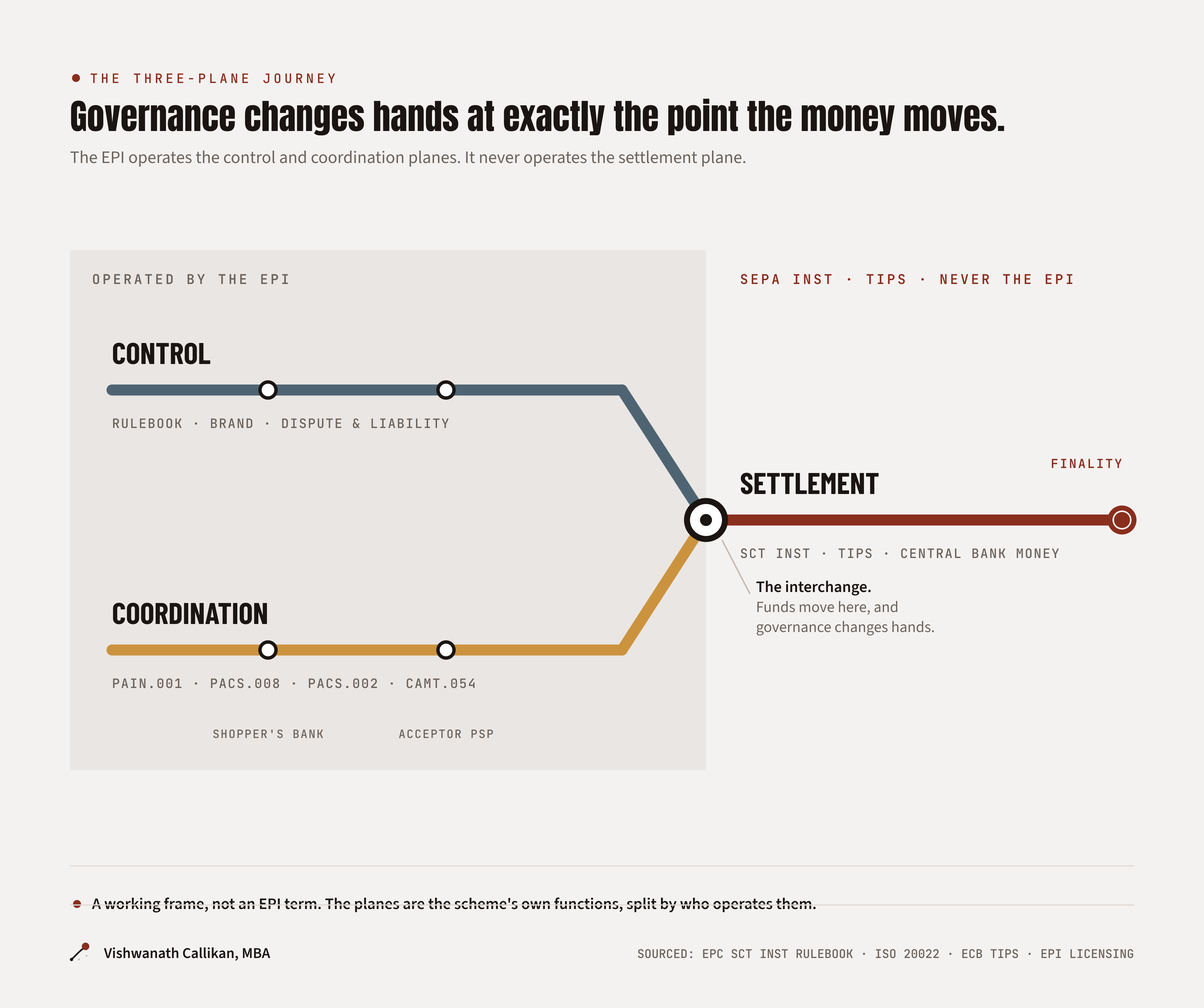
A payment scheme has historically bundled three things: the control (who writes the rules and owns the brand), the coordination (who orchestrates the transaction and holds its state), and the settlement (who actually moves the money).
The EPI, Europe’s account-to-account scheme behind the Wero wallet, keeps the first two and externalises the third. It describes itself as the scheme’s orchestrator and a payment-initiation and account-information provider, not a clearing house and not a settlement agent, which is what its payment-institution licence from the National Bank of Belgium actually authorises.
The money moves on SEPA Instant rails as Credit Transfers, settled across the Eurosystem’s TIPS. Pay a merchant with Wero and the funds go straight from your bank to the merchant’s acceptor PSP as gross, immediate transfers. The EPI’s central services sit alongside that flow, holding the state of every transaction without ever standing inside it. Hence the scheme that never touches the money.
Wero was designed this way on purpose. Across instant account-to-account (A2A) methods the same unbundling keeps showing up, where control, coordination and settlement come apart and whoever writes the rules, whoever routes the messages and whoever moves the money are, increasingly, three different parties. The EPI has taken it furthest.
The EPI owns the control plane through its payment-institution licence, its governance of the SCT Inst-based scheme rulebook, and everything that rulebook actually contains, which is a good deal more than branding. A scheme’s rulebook typically bundles the commercial model, the liability model, the dispute model, the risk model and the acceptance tooling alongside the brand, and the EPI is no exception. It sets out the dispute and liability model directly, and it runs a tiered compliance programme that places reporting and monitoring obligations on direct participants, tracking chargeback ratios against Observation, Risk and Excess thresholds. None of that is settlement, and all of it is control.
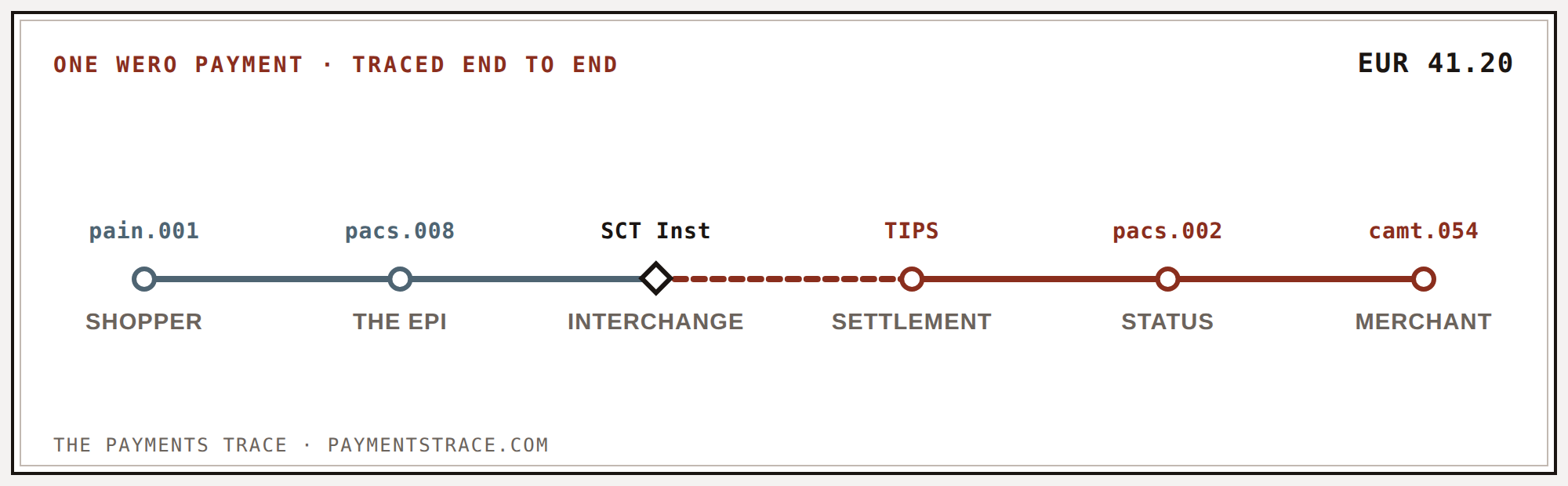
The EPI owns the coordination plane too, through central services that carry the ISO 20022 messages (pain.001, pacs.008, pacs.002, camt.054) routing a transaction between the acceptor PSP and the shopper’s bank and tracking its state end to end.
What the EPI does not own at all is the settlement plane, which is the SEPA Instant banking rails, push Credit Transfers, settled across the Eurosystem’s TIPS.
Governance changes hands at exactly the point the money moves
The figure is wider than a phone screen. Scroll it sideways, or use expand.
The regulatory perimeter around that control plane is also mid-shift. The EPI is authorised today under PSD2 and the National Bank of Belgium’s payment-institution regime, and like every EU payment institution it is heading toward PSD3 and the Payment Services Regulation, the package that replaces PSD2 and folds e-money institutions into a single supervisory framework, expected to start applying from around 2027.
The same picture holds from the other side of the table. Follow the acceptor PSP and the shopper’s bank through the three planes and they answer to the EPI right up until settlement, because the EPI’s Adherence Agreement binds both to the same rulebook and its central services carry the same ISO 20022 messages between them. Then, at the moment funds actually move, both parties step out from under the EPI entirely and transact under the EPC’s SCT Inst rulebook, settled on infrastructure the Eurosystem operates.
Governance changes hands mid-transaction, and it changes hands at exactly the point the money does.
The trace is wider than a phone screen. Scroll it sideways.
- OPERATOR
- The shopper’s bank app
- WHAT HAPPENS
- Initiation. A customer credit transfer request.
Cards, Pix and Wero give three different answers to who settles
Put the models side by side and the oddity becomes harder to miss. In the cards world a private operator runs the rulebook, nets the flows into multilateral batches (typically clearing in T+1 to T+3), sends each issuer and each acquirer its own settlement advice, and separately instructs its own designated settlement banks to move the resulting balance. The network never takes custody of the funds itself, and it does guarantee that the settlement happens. Visa and Mastercard each indemnify their members against another member’s funding failure, and both carry the exposure that comes with that promise.
With Pix, the state runs both halves. Banco Central do Brasil operates the SPI, the real-time gross settlement system, and every direct participant holds its own reserve account there, so the central bank is not just the rule-setter but the rail.
With Wero, a private operator runs the rulebook and settles nothing at all. The EPI borrows SEPA Instant and the Eurosystem’s TIPS underneath, a rail it neither owns nor operates, and it offers no equivalent guarantee. If an acquirer cannot fund a payment, the loss sits with the acquirer rather than with the EPI.
That risk does not vanish, it moves. In my view, asking acquirers to absorb an exposure the card networks socialise is a harder sell than the marketing suggests, and it is the sort of thing that gets negotiated quietly rather than announced.
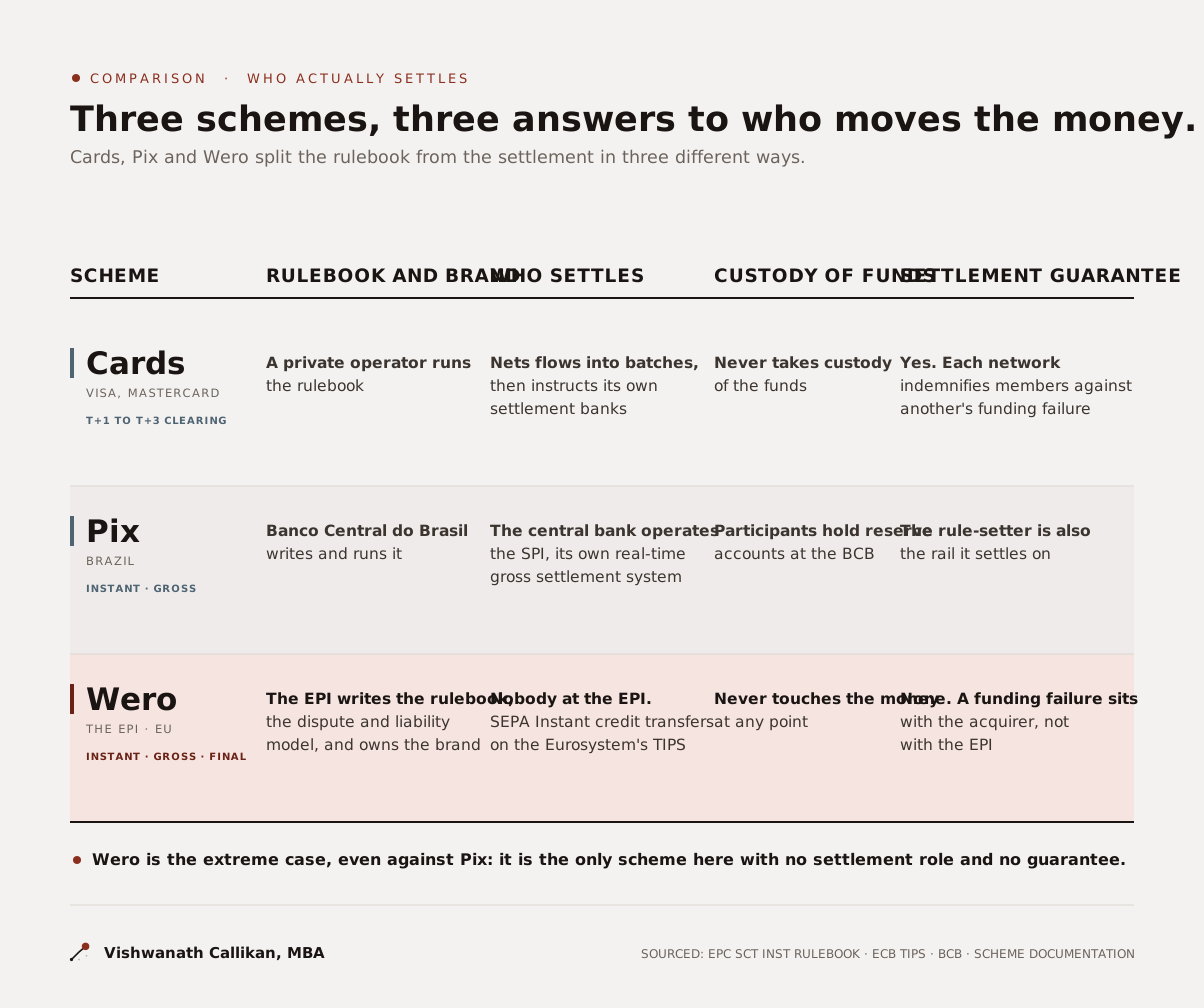
Three schemes, three answers to the same question, and Wero is the extreme case even against Pix. Pix’s central bank sits inside the settlement rail it built for itself. Cards sit a step further out, never touching the funds directly but standing behind the outcome as guarantor. The EPI does not go even that far. It leans entirely on infrastructure the Eurosystem built for other purposes, holds no settlement role in it whatsoever, and carries no settlement guarantee at all.
Pix and UPI show the pattern already running at scale
Zoom out to the broader payments landscape and the EPI looks less like a pan-regional experiment and more like the European instance of a pattern already proven elsewhere. Pix is on track for $6.7 trillion in transaction value in 2025, up 34% on the year before, and no other real-time payments infrastructure has scaled that fast, not even India’s UPI. UPI itself processed 228.3 billion transactions in the 2025 financial year and is now the largest digital payment system in the world by volume.
Instant A2A is not a niche alternative to cards, and in two of the world’s largest consumer markets it is already the default.
The EPI’s own ambition, and by extension Wero’s, sits in that context. In February 2026 the EPI signed a memorandum of understanding with the EuroPA Alliance, the coalition behind Italy’s BANCOMAT, Spain’s Bizum, Portugal’s MB Way and the Nordics’ Vipps MobilePay. Together the two networks connect roughly 130 million users across 13 countries, close to three-quarters of the combined population of the EU and Norway, and the trade press describes both as building a direct challenge to Visa and Mastercard’s European revenue. Wero’s own volumes are still early against Pix or UPI at maturity, albeit the direction it is chasing is not in doubt, and those volumes will only grow once consolidation takes place, including the medium-term replacement of iDEAL in the Netherlands.
Wero is an early and unusually pure example of where instant A2A is heading, a model in which schemes externalise settlement to public instant rails and internalise the rulebook, the brand and the dispute layer.
For decades the question was who owns the rails. Under a scheme that never touches the money, the sharper question is who can move money back out fast, and price the risk before it leaves. That is a different contest, with a different set of winners and a different moat. Wero is the first place in Europe it is being run for real.
Part 2 picks up exactly here, at what happens on the return leg when a scheme that never touches the money also cannot reverse a payment.